
What are Dynamic Text Fields?
Dynamic text fields are used to manage dynamic information in your certificates. In other words, the information displayed inside those fields can be different for each one of your recipients.
The most traditional example of a dynamic field in a certificate is the name of the recipient, but any other information can also behave dynamically.
There are 2 types of dynamic fields:
- Pre-defined dynamic fields: These fields are automatically populated by Virtualbadge.io when you send your certificates. The pre-defined dynamic fields are: Issue Date; Expiration Date (if enabled); and Certificate ID Number.
- Custom dynamic fields: Custom dynamic fields are used to manage any other dynamic information in your certificates. The information displayed in each of those fields must be mapped by you when adding the recipients.
How to add Dynamic Text Fields?
By default, dynamic fields are not present in the templates from the Virtualbadge.io template gallery. Hence, these field has to be manually added to certificates.
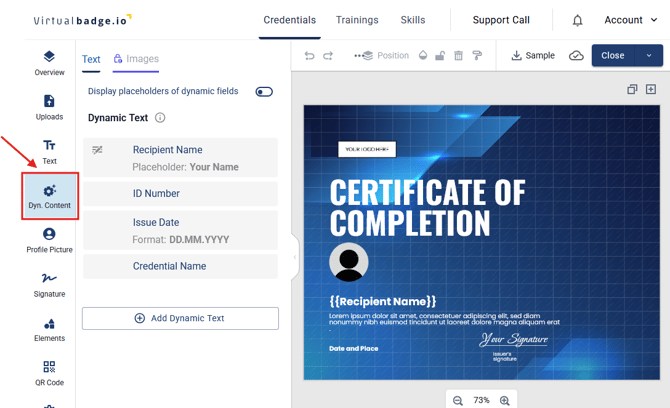
Within the Designer, navigate to the "Dyn. Content" tab located in the left-hand menu. This section displays a list of all available pre-defined dynamic fields. You can also create new custom dynamic fields from this page.
Adding Pre-defined Dynamic Fields
You can simply hover your mouse on one of the pre-defined dynamic fields, and click on the "+" icon. 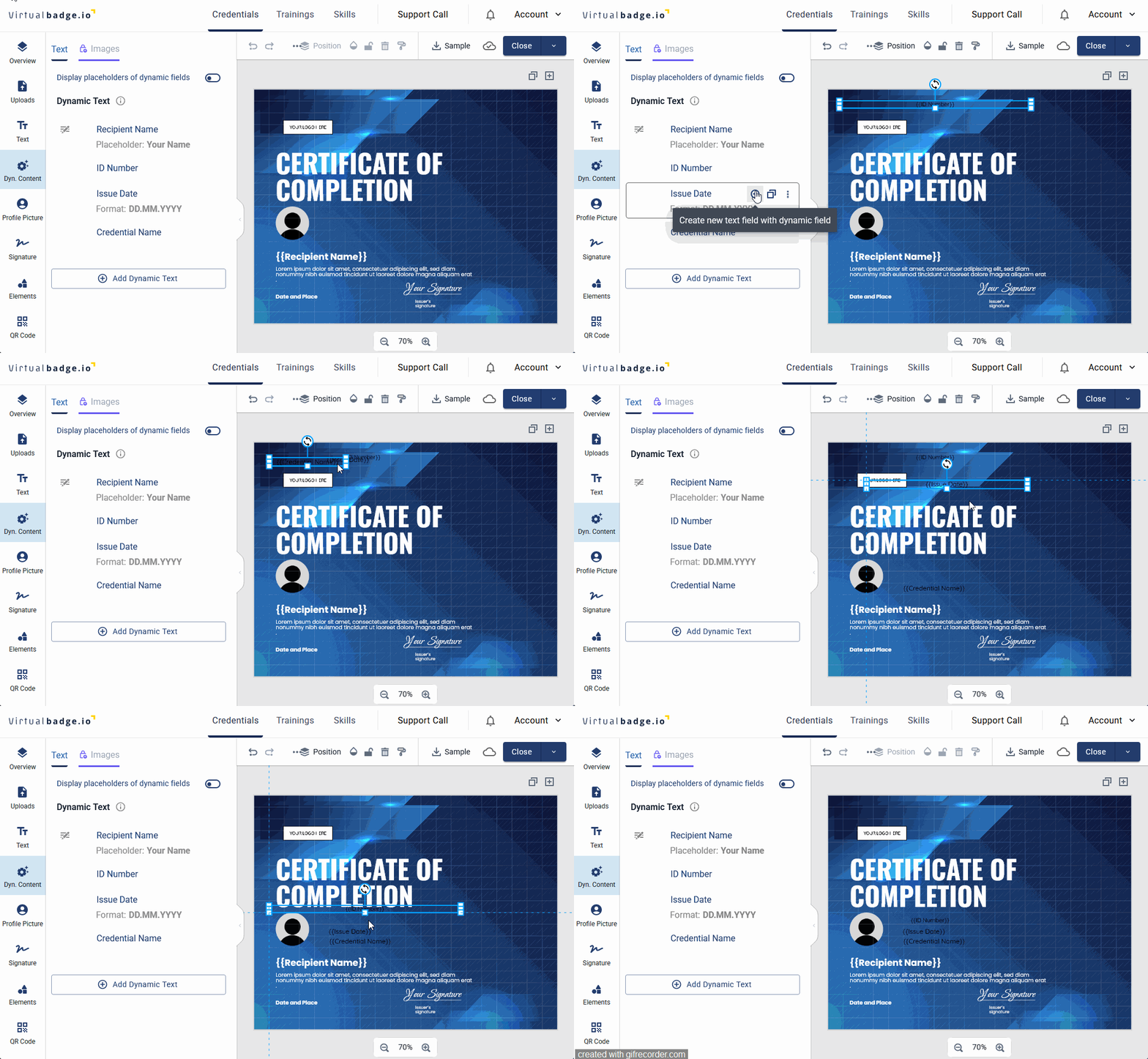
Here’s a quick overview of how each pre-defined dynamic fields work:
- Recipient Name: Added through your CSV upload.
- ID Number: Automatically generated by our system and cannot be changed through CSV uploads.
- Issue Date: Automatically created based on what’s defined in the Basic Details section, but it can be updated manually or through a CSV upload.
- Credential Name: This field automatically takes its text from the Public Certificate Name set in the Basic Details section.
Adding custom dynamic fields
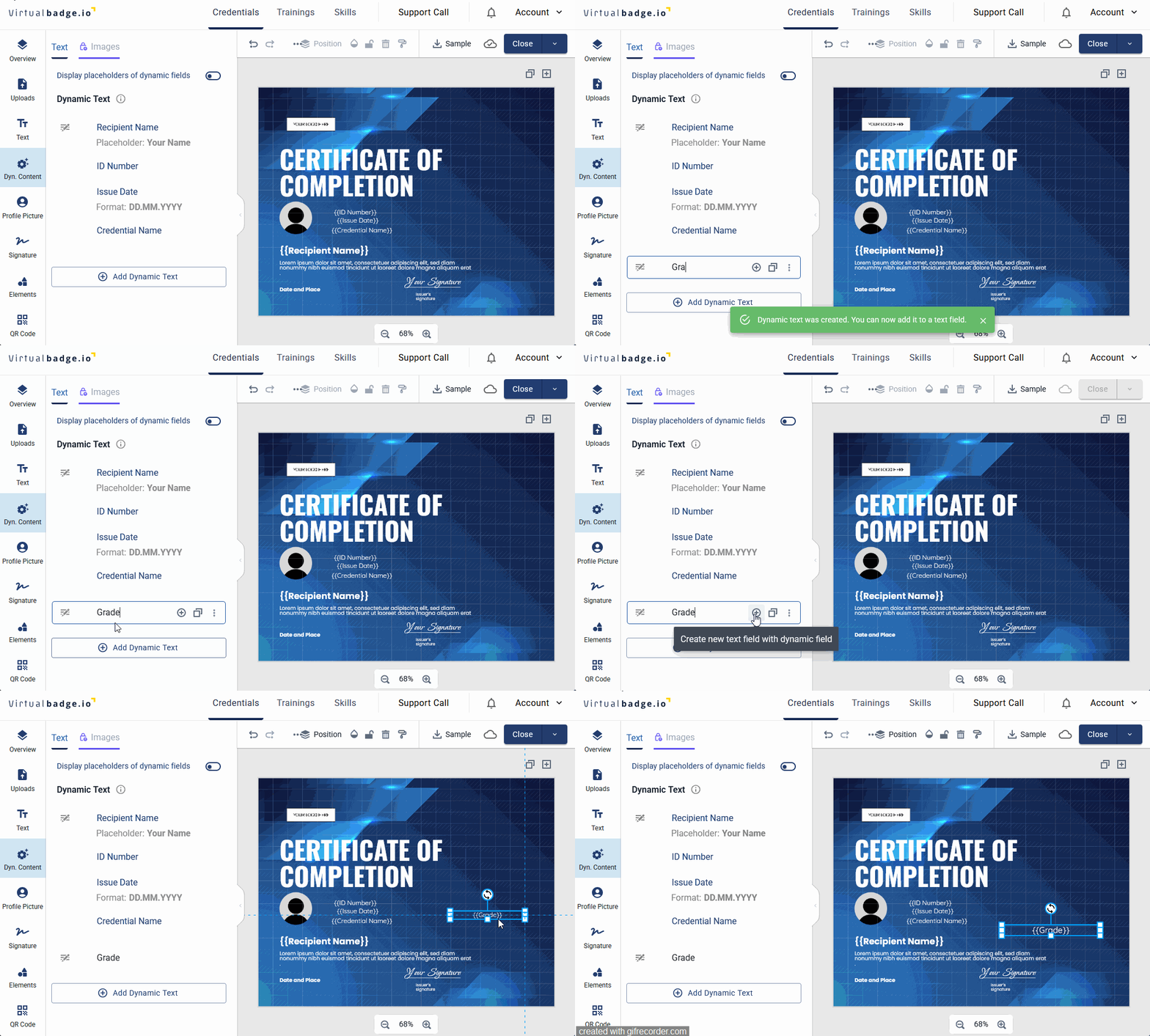
To create a custom dynamic field, click the "+ Add Dynamic Text" button. This will add a new dynamic text entry to your list, which you can rename to suit your needs. In this example, we'll name the field "Grade".
The name you assign to this dynamic field will also serve as its identifier when mapping columns from your CSV file or external integrations.
After renaming the field, you can place it onto your certificate by clicking the "+" icon next to the field name.
⚠️Text Behavior in Dynamic Fields
When the text inside a dynamic field is longer than expected (for example, a very long participant name), the field behaves in one of two ways: it shrinks or it wraps.
Shrinks: The font size gets smaller step by step until the text fits on one line. This happens only when the text field contains a single pre-defined dynamic field on its own, with no other text or fields next to it.
Wraps: The text moves onto a new line, and the field grows to make room. This happens in every other case:
- When you add fixed text next to a dynamic field
- When you place two or more dynamic fields together in one text field
- When you use a custom dynamic field — custom fields always wrap, they never shrink
Quick reference
- One pre-defined dynamic field, alone in its text field → text shrinks to fit
- Anything else → text wraps onto new lines
- Custom dynamic fields → always wrap, never shrink
What this means for combined fields
A text field can contain both a pre-defined field and a custom field at the same time — for example, the recipient name followed by a module name. As soon as you combine fields like this, or add any fixed text, the field will wrap. Having a pre-defined field in the mix doesn't bring back the shrinking behaviour.
If you want a field like the recipient name to shrink, keep it alone in its own text field.
Why a name sometimes wraps instead of shrinking
You may notice that a long recipient name wraps onto two lines even though it could have shrunk to stay on one. This is expected behaviour.
The field fills the space it's given. If the field is tall enough to hold a second line, the text wraps first — and only shrinks if there's still no room. So a tall field favours wrapping, while a short field favours shrinking.
Tip: If you want the recipient's name to stay on one line and shrink instead of wrap, make the text field only as tall as one line. If you want it to wrap, give it more height.
Tips for narrow templates and long names
- Test your template with a very long name, not just a short one — this shows you the worst case before publishing
- Keep the recipient's name in its own text field so it can shrink
- Keep the field height tight if you want a single line, taller if two lines are acceptable
- The text shrinks down to a minimum size before it wraps — on narrow templates, a very long name may become quite small, so check that it still looks good
A note on the preview
The live preview in the Designer and the final certificate are created in slightly different ways. In most cases, they look identical. With very long values in a tight space, there can be a small difference between the preview and the finished certificate.
Tip: Before sending certificates to a large group, generate one test certificate with a long name and check that it looks the way you expect.
How to add placeholder texts
Using placeholder texts is a great way to change the information displayed on the certificate preview images for your recipients.
The dynamic texts will appear in the editor as texts between curly brackets, such as and .
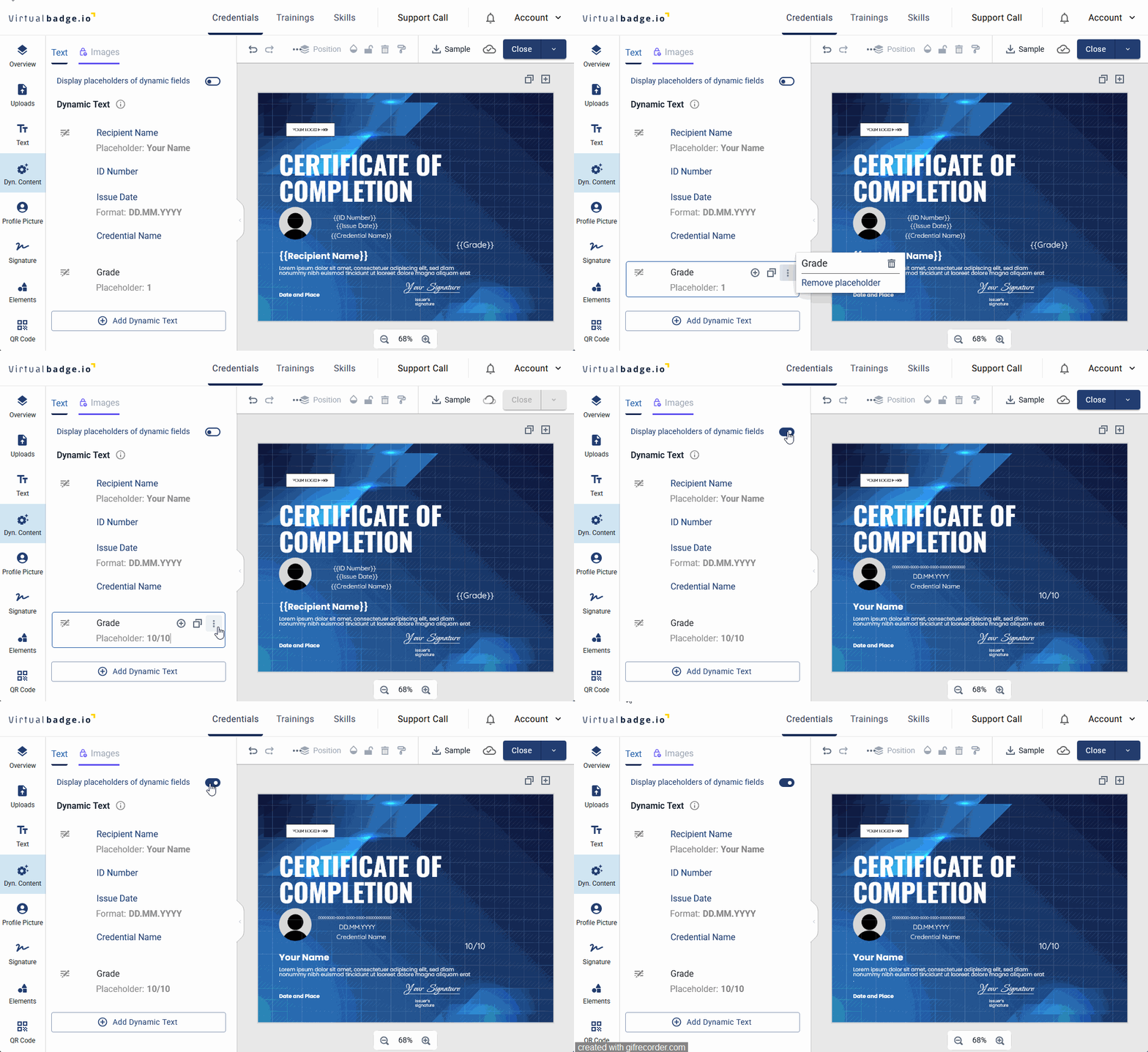
To change the placeholder texts of any dynamic field, just hover your mouse above the field and select the three vertical dots. Please note that the placeholder functionality is not available for all pre-defined dynamic fields:
To view your certificate with the placeholders, just enable the toggle on the left side menu:
Furthermore, it is possible to combine dynamic fields with static text to create a cohesive paragraph. For more information on this feature, visit this article.
Custom dynamic text fields are not available in the Lite plan.
How to map information to Dynamic Text Fields?
Now that you have added Dynamic Texts to the design of your certificate, you must map the information that will be displayed in those fields for each one of your recipients.
You can prepare the CSV file with your recipient information and add one extra column for each dynamic field of your certificate:
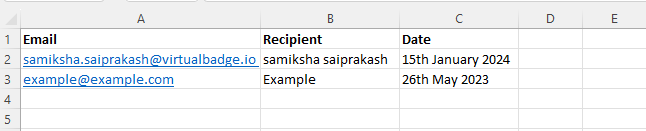
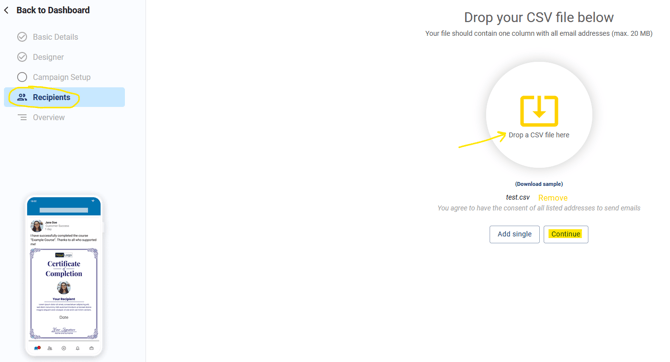
Now upload the CSV file to the Recipients tab. Other alternatives: You can manually add each recipient or use Zapier or our API to automate this workflow.
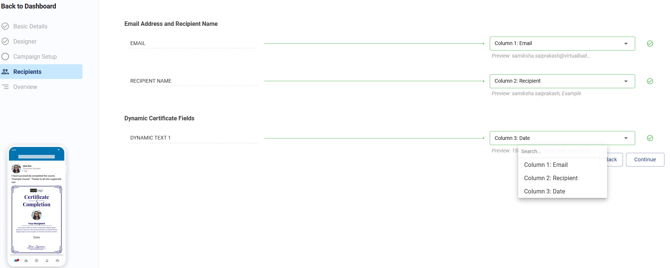
Now you can map each column on the CSV file to the correct column on your certificate. The name of the columns will be the same as the names that you have given the custom dynamic fields on the tab "Designer".
And that is it! Now you can proceed with sending your digital certificates. Each person will receive a link to claim their certificate via email.
Deleting dynamic fields
Please note that once recipients have been added to a certificate, dynamic fields cannot be added or removed. To make changes, you will need to delete the recipients first.
To delete a dynamic field, navigate to the Designer and open the Dyn. Content tab. Click on the three dots next to the dynamic field you want to remove, then select the trash icon.
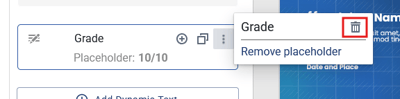
Once deleted, the system will no longer request this field when adding recipients via single entry, CSV upload, or API.